Showing posts with label Kimono. Show all posts

My Back Pages

(L-R: Iso-san; Hanazaki-san (standing), pear farmer and wife, my mother Lynda Hyacinth Joseph
It's been an exciting past two days, as the people of Japan have really taken a shine to my mom, Lynda, as she visits Ohtawara-shi (City of Ohtawara), Tochigi-ken (Tochigi Prefecture), Japan from Toronto.

I've been here 13 months already, so perhaps I am old news to the people of Japan... but then being invited to participate in - not just watch - the Sakuyama Obon Matsuri (Sakuyama Festival of the Dead)... well, it's nice to feel good again. I've been on a major downer lately as my girlfriend or woman troubles have really taken their toll on me. I'm not clinically depressed or anything, but I wonder if anyone I know is? Hmm. I'd ask, but I'm too much of a coward.

Yesterday, the OBOE (Ohtawara Board of Education) took my mother and myself all around the outskirts of Ohtawara to see sites I've not even seen before. I'm unsure if that was because my mother was with me or if it was because I brought a large bottle of good Canadian whiskey for the OBOE superintendent.... I'm sure it was my mom!

It's Thursday, August 19, 1991, and I go into the office again in the morning. My vacation is up, so even though there is no school for me to teach due to summer vacation, I am still expected to be at work at the OBOE. That's fair, of course.

At the OBOE, I try to sort out the upcoming issue of the Tochigi JET (Japan Exchange & Teaching) Programme newsletter, The Tatami Times. I'm the editor-in-chief, which means I have to put the content together. Because a lot of new people have just arrived in Japan (and Tochigi-ken) one month ago, I need to make sure that I present them with interesting and useful materials along with the usual mindless comedic crap. The magazine is a mess... as I have no idea what to include or where to put it. I actually have too much material.

I head home at lunch and then pick up my film (or rather my mom's film) from the Iseya department store. When you receive your film back (remember, this was 1991!), the clerks open up the film envelope and show you a photo so that you can assure them that it is your film.

At Iseya, the place is essentially run by pretty young Japanese girls in their early 20s. They took great delight in opening up my mom's entire set of photos and placed them out for me—and the other young girls they called over—to see. I am always an object of great amusement for them. I wonder why I've never asked any of them out? I guess I need to gain greater Japanese language skills.

They ask me all about the places in the film, and who is taking photos of me. They giggle with delight as I try to explain that it is my mom's film and that I do not have a girlfriend right now.

I head home totally bedazzled by all of the female attention and chat with my mom a bit before heading back to the OBOE at 1PM. Hanazaki-san asks me with a pained look on his face of I am busy.

"No."
"Then let's leave."

So we do, dropping my my apartment to pick up my mom. I love surprises!

Iso-san, the gentleman who usually drives us around in his white van, joins us, but this time we are in Hanazaki-san's white Jaguar... what he calls his Toyota Camry. I'm telling you, I got lucky! My office crowd has a wonderful sense of humour... I've heard of other offices for AETs (assistant English teachers) are often rather dour.

Oh... and juts so you know, I had already given Iso-san (and Hanzaki-san) a present earlier, to thank him for looking after me here in Japan. It's nothing great, but it's from the heart.

We first go to the Sakuyama district (in Ohtawara) pear farm I visited last year (photo HERE) and get to load up on free pears and grapes. Okay, I do the loading up, as my mom is leaving for Canada tomorrow. Remember mom - don't tell Canadian customs you visited any farms!
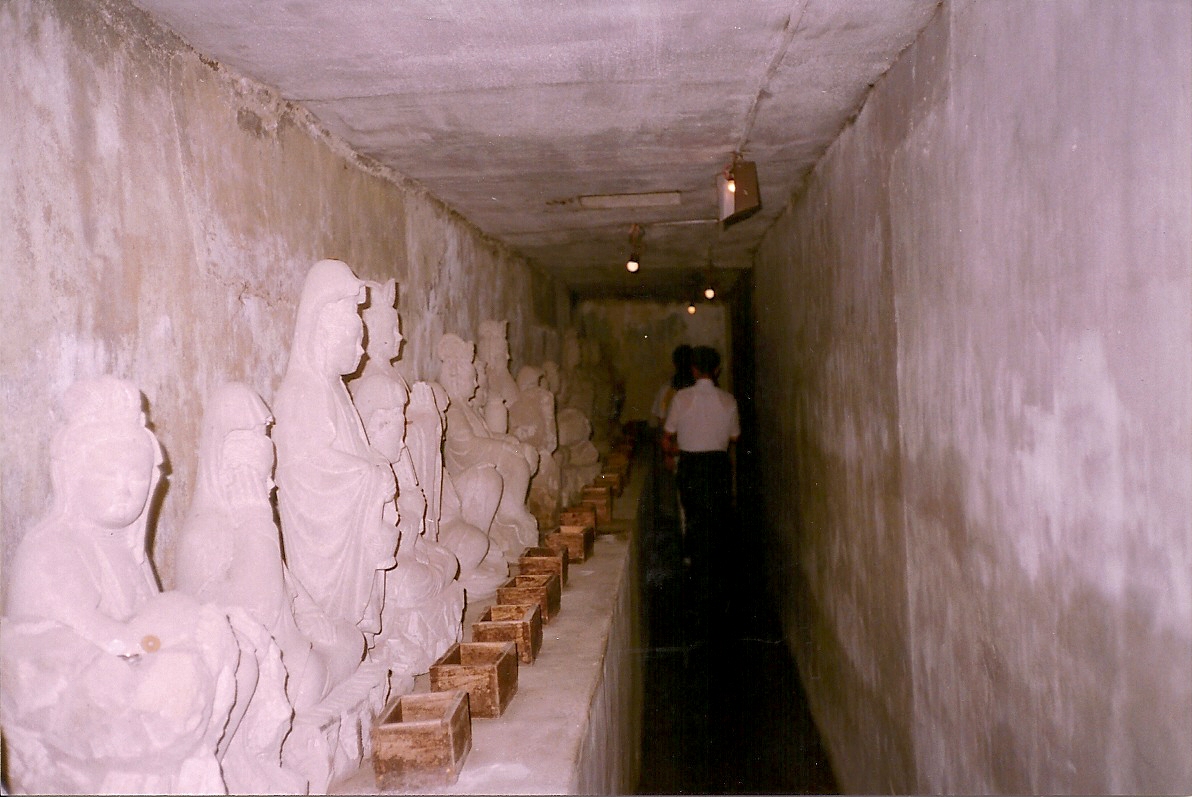
Catacombs with 100's of Buddha statues.

Then we drive out to Yawn, sorry, Yaita-shi (Yaita City) to the Sawa Kannon-ji (fountain spring-goddess temple). It's about 400 years old and is in really great shape. We head down into its catacombs where there are hundreds of Buddha statues! Back topside, my mom and I load up on good luck charms (all of which I lost in my house fire three years ago).

It's raining now. What with Ame Otoko (Rain Man = me) and Ame Oka-san (Rain Mother = my mom), how could it not?

Iso-san then takes my mom over to the kimono school across from the Nozaki-eki (Nozaki train station) that is currently the only JR (Japan Rail) station in Ohtawara. To me, it's actually farther away than the one up at Nishinasuno-machi (Nishinasuno Town) to the northwest of Ohtawara.

My mom tries on a kimono... photos galore via her camera, and just to prove that it's not really a mom-thing, but a camera-thing, it runs out of film. I can see now in 2011 why digital cameras are so awesome.

Kimono school teacher and my mom.
My mom bought a kimono - just not this one... hers was purchased while out west. I'll see if it still fits me and take a photo. Not.

The school has a scale there to weigh bolts of cloth, so I get on and weigh myself, coming in at 77 kilograms (which is just under 170 pounds). All right! I've lost 3 kilograms (~6.5 pounds) since arriving. How the heck did I do that considering all of the booze I've been imbibing?!       

We then head back to the office, as I'm supposed to meet the new English teacher taking over for Nozaki Chu Gakko's (Nozaki Junior High School's) Ishihara Norko-chan (surname first), who was a good friend of mine. She introduces herself as Mrs. Hiyama... so I have no idea what her given name is.

Her English is rusty, but she's really nice and we chat for an hour. Why won't she leave and go back to her school?!

Hanazaki-san then drops us off at my apartment, and by US, I mean myself, my mom and Hiyama-sensei (Hiyama teacher). I guess bevause it was raining, I left my bicycle at the office - and it is now, in fact, pouring like someone should be building an ark and gathering the animals.


I was supposed to have dinner in Nishinasuno tonight with all of the other AETs in our northern section - including Karen, the new girl in Yaita who wants to be my girlfriend. I just want to get laid. I don't want a relationship. Anyhow, since it's my mom's last night here, I stay home and eat a burger and fries dinner.

Naoko and Suzuki Tokunori (the gentleman who allowed me to participate in the Sakuyama Obon Matsuri) come over to make their good-byes to my mom. I think she wishes I would have hooked up with Naoko, as she really took a shine to her.

She shows Naoko some photographs of her trip to western Japan, making sure she sees pictures of a guy she met that she thinks would be perfect for Naoko. Ah... my mom the pimp.

Everyone wants to talk to my mom - including Hiyama-sensei who is still there and joined us for dinner. I have to admit, it was nice to not be--or want to be--the center of attention for once.

Naoko, ever the classy broad, phones for a taxi to come and pick us up tomorrow. Nice.

Somewhere wishing these past three days could have lasted forever,
Andrew Joseph
Today's blog title is originally a Bob Dylan song: This VERSION is sung by Roger McGuinn (The Byrds, whose version of this song I love), Tom Petty (& The Heartbreakers), Neil Young (Buffalo Springfield; Crosby, Stills, Nash & Young - he's Canadian),  Eric Clapton (The Yardbirds; John Mayall & The Bluesbreakers; Cream; Blind Faith; Derek & The Dominoes - his dad was Canadian), Bob Dylan, George Harrison (The Beatles). Ah, but I was so much older then, I'm younger than that now.
PS: The photo up above is indeed one from my mom's camera - I took it. Hard to believe my mom is Indian with that complexion, eh? Plus, she's 52 in this photo. I refrained from posting a photo of her until this moment, her last fun day in Japan... she died two years later of a disease you only hear about on the television show House. It breaks my friggin' heart to look at her photo, let alone write about her. I know she would have laughed her head off reading every single one of my Japan - It's A Wonderful Rife adventures. She missed me getting married, having a fantastic son, and would have been there for me when I needed her the most. It hurts everyday knowing that and living in the house where she died. Crap. I'm tearing up now.

White Wedding

Okay... A few days back, I posted my initial reactions to a Japanese wedding. While I was darn near exact in providing detail with what I actually saw happen, I didn't really explain things to you - probably because it was never explained to me.
Now... thanks to the Internet, one can find out whatever information they need virtually instantly. I've actually been 'on-line' since the late 70s, when I used to message board with other like-minded individuals. Having always been impressed with the power of the computer, I decided to say 'screw all that' and did some research the new old-fashioned way - with a book. To me, the old, old-fashioned way is through verbal communication... and no one does that anymore. Everyone is too afraid to say what comes to mind. Political correctness or just correctness be damned. Others, like my wife, prefer to write stuff down so that it's organized - so one doesn't come off looking like a doofus.
Obviously, I do the same here in writing down these blogs, but it doesn't stop me from looking like a doofus.
Now with what passes for humour out of the way, let me offer some insight on kekkon (weddings), that I never learned because I did not get married in Japan. I got married in Las Vegas, and you know the old saying... what happens in Vegas, stays in Vegas... so I can't tell you about that either.
Okay... now I've really got the comedy out of the way.
Apparently one out of every five marriages in Japan is done via an arranged marriage, rather than the type where two people in love decide to marry each other. Some find love and marriage - others have it thrust upon them. I believe the Kanemaru's (one of my bosses from the Ohtawara Board of Education), were an arranged marriage... and they had three kids and seemed very happy.
In a kekkon, Japanese folks can have either a Christian-, Shinto- or Buddhist-style ceremony - and are usually a private gathering with close family members. I never got into that inner circle despite my good looks.
 In the traditional Shinto wedding ceremony, there is chozu, where there is a ceremonial purifying washing of the mouth and feet when they enter and after they are seated. Next, the priest performs a symbolic purification ritual called a shubatsu. Then there are prayers offered by the bride and groom's representatives, and then the sankon where the lucky couple exchange cups of sake (Japanese rice wine) - drinking three times each from three stacked sake cups brought in by a shrine maiden (miko).
The bride and groom read their vows, exchange their rings (the woman puts it on her right hand). Then they make an offering of tamagushi at the alter, and then the relatives have some sacred sake (it's all called sakazuki) showing the family bond between the two families now made one.
And that's pretty much it. Shinto is beautiful in its simplicity and sake.
As mentioned in my previous wedding blog, the reception following this is an extravagant, over-the-top affair that defies explanation, but that's why it is cool.
The wedding cost is shared by the parents of both newlyweds, so to me that makes it perfectly all right if they want to come on the honeymoon, too. And they do.
I mentioned that the bride changes clothes a few times... well, if you think it's tough to purchase a single wedding dress for that special day in Europe or the Americas, Japan has us beat.
The shinto ceremony, and the initial introduction at the ceremony has the bride wearing a white kimono called a shiromuku. Beautiful plummage. A large wig with a white headdress is also worn (I believe its a wataboshitsunokakushi and or a style headdress).
Later, the bride will change into different styles of kimono like the irouchikake and the furisode. All beautiful, and even to the casual observer, it should be apparent that all are completely different in style.
The men... they wear dress pants and jacket (the haori hakama). Pretty boring, but they too do a change into a suit, or something more casual - it is a party, after all.
And how much can these wedding ceremonies all cost? Well, a book I found from 20 years ago says: for a ceremony, the reception, honeymoon, and costs to set up a new home, it can cost about Y57,000,000 (which according to today's exchange rate, is about $85,000 Cdn.)
I know that seems like a lot, considering my wedding, reception and honeymoon was a tidy $4,000 Cdn., but it seems to be in line with the average wedding costs here in North America.
There. Don't say you don't learn anything from this blog.

Somewhere at a wedding drinking for Pete's sake,
Andrew Joseph
Today's title is brought to you by Billy Idol, and even though this song might be about drugs, it could also be about a WHITE WEDDING.

Girls, Girls, Girls

Interesting photo, isn't it?

It is a hagoita--a paddle used for an old girl's game called hanetsuki that was played usually on New Year's day (January 1... I only write that date down because, well, other cultures do have different New Year's days...).

Similar in scope to badminton, a shuttlecock (hane) was whacked back and forth between two girls. Obviously... this front highly decorated portion of the hagoita was not used to hit the hane - the reverse flat side was.  

Apparently there were no nets involved - just keeping the hane afloat like a game of hackey-sack - was the point. However, should a girl miss the hane, her face would be smeared in ink. The game would continue until one girl's face would be completely covered in ink. Sounds like fun, ne (eh)?


The hagoita paddles are part of a ritualistic health blessing to the girls given at birth, and is thus a good luck charm. Rumour has it that it was also a way of providing protection against mosquitoes. If so, it's the world's best looking fly-swatter.

The game is no longer played in Japan, but like all things in life, the hagoita paddles have become collectible decorative items--which explains why I have one.

This was given to me by a student over at Nozaki Chu Gakko (Nozaki Junior High School) - what great kids (now adults and parents probably in 2010!)

Traditionally, the front artwork is created through the Japanese art of washi (hand-molded paper), through mine has elaborate needle and thread work. It's three-dimensional plush and pasted to the wooden paddle to protrude like a relief. Mine depicts a beautiful woman in kimono--in this case, I believe it is a geisha - though other hagoita features portraits of popular Kabuki (style of performance play) characters or actors, or the more modern anime (cartoon) figures.

The reverse of mine is painted with a bamboo grove design--as well, mine is a more traditional paddle size of about 60 centimetres (2-feet) long. 

There is a Hagoita Ichi Fair held in the Asakusa-area of Tokyo on December 17-19 every year. Started about 350 years ago during the Edo jidai (when Japan was essentially closed to foreigners - read about it HERE).

It's set up at the Senso-ji (ji means temple) grounds with about 50 kiosks set up with vendors hawking nothing but their hagoita wares. It's a spectacular fair with some 300,000 visitors annually attending. 

Somewhere there is ink smeared on a young girl's face,
Andrew Joseph
Today's title is by Motley Crue - HAIRSPRAY.
And, since that sexist hair-metal song may not be everyone's cup of tea... maybe you'll enjoy this clip about paddles from a Simpson's substitute elementary teacher. It's one of my all-time favourite lines to quote: JASPER.
PS - Today's entry is my 200th Blog of Rife. Happy Blog-day to us!

Borders

What's the big difference between Canada and Japan? Two words: cultural identity. Canada lacks one, while Japan has it in spades. Part of that is due to immigration issues regarding its borders: Canada can't say no, and Japan can.
From 1633 until 1868, Japan was Sakoku (鎖国 which translates to 'locked country'). It was Japan's foreign relations policy that essentially stated no foreigner could enter nor could any Japanese leave the country upon penalty of death. Pretty severe, huh? 
The policy was enacted by Japan's ruling shogun, Tokugawa Iemitsu, through policies enacted between 1633-39, and remained until Commodore Perry sailed into Japan in 1853 - though it was still illegal to leave Japan until 1868, the so-called Meiji Restoration
But, you know what I find very interesting? The word 'sakoku' was created in 1801 by Tadao Shitsuki who was translating writing by German Engelbert Kaempfer, who wrote about Japan. It was inspired by a foreigner, in other words.   
So... why shut out the world and keep Japan secluded? Well, the Tokugawa family who ruled Japan had in 1616 killed the Toyotomi family who had previously ruled. While Tokugawa Iemitsu's father and son's were warriors and thus more respected, Tokugawa Iemitsu wasn't. 
To maintain control, be essentially became a pain in the butt. Lords of the provinces had to visit Edo (old name for Tokyo) every year bringing tribute - and even had to leave their wives and children there as hostages. Paranoid? Yup.  
Then there was the thought that foreigners were conspiring to rise up the populace in rebellion - and here, the shogun may not have been paranoid. He thought the Spanish were interested in overthrowing his reign with their Christianity.
Even further back in the 1570s, Portuguese Jesuit missionaries were welcomed by local rulers in western Kyushu area of Japan, who benefited from the lucrative Portuguese trade in Chinese silk. 
Then there were more foreigners arriving - Spanish friars, English and Dutch traders - all in competition with each other. 
In 1587, the initial tirade against missionaries began - first decrees expelling them, and then actual action. In 1597 in Nagasaki, 26 Christians, nine foreign missionaries, and 17 Japanese laymen were - in a unique bit of irony, crucified. Take a look at the photo up above - that's the memorial for the Nagasaki massacre.  
Now... you have to understand... I'm not making excuses here, but the Christians did have a way of marching into a country and stripping it of its beliefs to save the poor heathen bastards, and by 1597, there were some 300,000 Christians in Japan.    
Back to Tokugawa Iemitsu,between 1622 and 1633 he had 131 Christians executed in public spectacles seen by thousands of people - to ensure the rest of the country got the message that while might be good for your soul, it is rather bad for your health. 
After a rebellion by 37,000 peasants and ronin (masterless samurai) in 1638 - some Christian converts--the Japanese shogunate massacred them.    
The closing of the borders was made to protect the shogunate, though for some reason, the Dutch were allowed to continue trading - but only in a small area of Nagasaki.  
With the regime change in 1868, an estimated 30,000 "hidden Christians" came forth to revive the church in Japan.  
All well and good, right? But Japan still was a some-what closed society. 
While foreigners may indeed have been allowed back in to Japan, they stuck to the larger cities, like Tokyo, Osaka, Nagasaki, and others. The rest of Japan, never got to deal with foreigners all that much--something that continued on well into the 1990s (World War II excepted, of course).
I think that is a reason why locals in the smaller towns will stop and stare and  say, "Hora! Gaijin-da! (Look a foreigner/outsider!)"... we're still a bit of a rarity.
Even nowadays, Japanese folk when talking to a foreigner--like myself--will always say things like: That is a Japanese kimono; or those are Japanese chopsticks; or ask if I like Japanese rice. There's a sense of pride - it's not really bragging, because if it is, it's kind of lame. 
The Japan Exchange & Teaching Programme is a fine way for Japan to get foreigners into the small towns and cities. It's not like we are really needed for English teaching--at least not back in the 1980s and 90s. I think we were there mostly to internationalize the Japanese - to let them know that we aren't a threat, but mostly, that despite a few cultural differences, we are just like them.

Somewhere  
Andrew Joseph
Today's title is by The Sunshine Underground - listen HERE. It's a cool little song from a U.K. group.

Changes

Here’s a little speech I gave back in April 1992 for the third-year graduation class of Ohtawara Junior High School (Dai Chu) who would be moving on to various high schools, trade schools, or perhaps the family business.

In the photo here, you can see me dressed to the nines in a fancy traditional Japanese male kimono. My friend, Inuoue-sensei – who was the head of the English department at Dai Chu – had arranged the garb for me. Apparently a few weeks earlier, someone from the costume shop was asked by him to come and measure me during a visit to the school.

While I had no idea what the heck was going on or what it was for, I want to you know that I didn’t create a fuss and question it. I just rolled with it, as I figured whatever it was for would eventually be presented to me.

That’s what living in Japan for almost two years had done to me. These people were my friends and were always looking out for my best interests. It was best to shut up and see where it would end up. It’s a journey… and sometimes it’s best not to have the end presented to you too soon.

I look good in that photo. But it saddens me that I have no idea if my pal Inuoe-sensei is still a part of this mortal coil. Briefly, he always reminded me of Dean Martin in his Brat Pack days. Not in the way he looked, or his smoking or drinking abilities—we bent a few elbows in our day—but rather it was the way he carried himself… there was a self-assured confidence… a swagger, that I didn’t see too often, as the Japanese way is to be a tad humble. He wasn’t an egomaniac – far from it – but he exuded something that told me he would have been cool no matter what country he was in. Look at him beside me in that photo... smoke in one hand, other hand in the pocket... he oozes style, man. What a great guy! I'd love to hear from him. 

He and I once did the taboo thing and talked of salaries. I told him I made the equivalent of US$36,000 a year… and he, after some calculation noted he made about US$27,000. The man had been teaching for nearly 20 years. There’s something wrong with the educational system… but this isn’t about the underpaid teachers, rather it’s about the stressed out students. Here's my speech:

Has another year passed already? Where does the time go?

When I first arrived here nearly two years ago, this year’s graduates still had that wide-eyed innocence of youth. They were always smiling and laughing and running around screaming at the top of their voices.

Then I noticed a change. As the year continued, the students became less silly and more serious. When they began their third year, they became what the teachers all over Japan call ‘death-like’. The students always seemed tired (probably from studying late into the night or going to Juku*). They no longer spoke very loud in class. To me, it was like someone had killed their youth.

Don’t get me wrong – it’s like this in every school. But, I fear that Japan’s current educational system often forces young people to grow too fast, with little time to enjoy themselves and their family.

Why do students all seem to go to Juku? So they can get into a good high school. If a student doesn’t get into a good high school, they may never get into a university and then will never get a job as a salary man for some company. It is true that if a student makes a mistake when they are in junior high school, it has affected the way their entire life will be. At the age of 15 – and to me, that’s not right.

It’s too bad that the best advice I can give you graduates is to: relax and have fun. I wish you could. But I know you have to study and I know you need to ensure you prepare yourself for the future. It’s the way things are here in Japan.

Did you know that in virtually all other First World countries, students get numerous chances to upgrade themselves, to change their goals. In Japan, if someone wants to change their career, they are scorned rather than admired. My father was 52-years-old when he quit his Y12,000,000 a year job to find another he would be happy in. He now makes less money, but he his happy.

I will be almost 29-years-old when I leave Japan next year, and that is when my career will begin. Not at the age of 15.

Graduates: I may not have been the best English teacher, but that’s only part of my job. Surprise! It’s to internationalize you. To teach you that there are different ways to do things—not just the Japanese way.

It’s okay to be different. It’s okay to be yourself. It’s okay to have dreams. And it’s important that you try and fulfill them.

Good luck, my friends. May you have the courage to make your dreams come true.

Your friend An-do-ryu.


Graduating 3rd Years being applauded by classmates at Dai Chu - March 12, 1991.


Pretty harsh, huh? Maybe. But my goal was to plant a seed of doubt – to hope that maybe one or all of them would be an architect of change. Not just in the educational system –but… well, whatever they want to change. Japan has wonderful traditions – and I hope they remain. But when I once asked why the pens are always kept on a certain part of the desk, I was told, ‘because that’s the way it’s always been done.’ While that attitude is a Japanese attitude, it doesn’t mean I agree with it. Even the Japanese people I’ve talked to about this way of life suddenly realized that maybe not everything should be accepted – that maybe someone should start asking questions. Maybe after 20 years, someone has gained the courage to do something about those questions.

Somewhere changing,
Andrew Joseph.
Today’s title is by David Bowie – and can be heard HERE.

PS: *Juku is a night school cram class – private, I believe – that preps the students for either their high school or university entrance exams.

Fashion

Special thanks to Special K. - Kristine South who sent me a document via e-mail about the latest fashion trend to hit Japan. Uh... that's the image to the left.

Now before everyone freaks out - it's a print applied to the fabric. People aren't really showing off their derriere.

Having been (past tense, in case my wife reads this), an aficionado of the female form in Japan, I've noticed more often than not that there is a decided lack of roundness to the female buttocks. I swear, I have no knowledge of the Japanese male rear - if I had noticed, it's not part of memory files. If I did still remember, I'd tell you.

Anyhow, if you glance again at the photo(s) scattered in this blog, the rumps on the dresses look pretty good. Too good. It's why I wasn't fooled for a moment. Obviously not every person lacks a well-rounded rump (and I'm not talking about bubble-butts)--and it certainly isn't a defect, I'm just passing along an observance. And, yes, I did date more than a handful of Japanese women. Like I said, this is not a criticism, it's actually more of a critique.

So... I can see the allure of wanting to give the appearance of having a well-rounded physique, but, and I'm no prude, this new fashion statement is rather bold.

Japan is well-known for it's kooky inventions for things you and I would never even think there would be a use for (I sense another blog topic) ... and this seems like another mis-step in Japan's thirst to become something it isn't.

Let me just come right out and say this: Japan's fashion sense--excluding the awesomeness of the kimono--is a few steps behind being chic.

I love Japan. I love the people. I love the food. I love the history. I love the culture. But darn it all, Japanese fashion leaves a little to be desired (at least by Western tastes).

One of my Japanese girlfriends (yes, plural) told me that Tokyo girls (circa 1990s) wore a lot of black coloured clothing (nothing wrong with that). Osaka girls - a few hundred kilometres to the west of Tokyo, well they wore more colourful garb. It's true - at least as far as my observances went.

She told me that while Japan's fashion industry was centered around Tokyo, Osaka took its cue from a more European influence.

Now, while the women are pretty, I can honestly state that I was rarely blown away by someone's garb--well, in Ohtawara (north of Tokyo), we had one woman--Narita-san--who dressed so against the grain that she stood out--and not in a negative way. She was loud, funny, slightly obnoxious - and was probably more western than most westerners. You can see a photo of this styling woman here to the right. Her... I miss.
Narita-san

Hey - I'm not saying us guys and gals on the JET Programme were stylin' either. Though, some of us did, like me (ego-maniac!).  And Japanese men - just like western men - we get a suit and a tie with colours ranging from blue, black, brown, silver and grey. It's rare to see a colour other than that, and even nowadays, if you see a man dressed in a suit not of those colours, you're going to do a double-take.

Back to the issue at hand. I've critiqued the standard Japanese fashions the average person wears. Don't believe me? School kids wear Victorian sailor uniforms and/or full track suits with a solid colour and white stripping or lettering.

They have ugly indoor slippers for the home, and uglier green slippers for the household water closet (W.C. or bathroom). Even my girlfriends - while always nicely dressed, there was never anything that made one go 'whoa'. Those kimono did, however - but they were only wheeled out for special occasions. Geisha? Rare. I'll fill you in on another blog.

Granted I lived in a farming city - but I did travel around the whole country (though I did not make it out to Hokkaido or Okinawa). And, while again I reiterate that there was little superb fashion to ogle, I can state that it is rare to find people there who are willing to buck the trend. Remember: Deru kugi wa utareru  (The nail that sticks up, gets hammered down). It's a Japanese way of life.

I'm sure the photo of the women (I'm assuming they are women) wearing these butt dresses are professional models - and that perhaps a few Japanese women will buy one - but sticking out like a sore bum, I mean thumb, is not something individual Japanese folk are known for.

Now I could be wrong about the Japanese not wanting to stick up - afterall, 20 years ago, the main purpose of the JET Programme was to internationalize (not to teach the kids English). That's my opinion. We wanted to show them that there was more to the world than just Japan.

Butt, hopefully we didn't go too far and make them think this is a good fashion statement. Still, the Japanese birthrate has been in freefall for a number of years as Japanese women are either delaying having a family or are forgoing it entirely... something that in the past would have been considered so un-Japanese. 

Somewhere, the butt of most jokes,
Andrew Joseph
Today's title is by David Bowie, who knows something about FASHION. I was going to use The Doors 'The End' as a title, but this episode is more about fashion as a whole. Man, there are so many jokes to make here.

Talent Is An Asset

Geisha in Kyoto - on a Telephone Card
For those of you going to Japan and expecting the place to be crawling with white-faced women in kimono's - let me set the record straight. That's not Japan. At least not anymore.

What is a Geisha? Well, for one thing, they aren't prostitutes. Geisha translates into gei (art) and sha (performer). Art performers - specifically performing traditional Japanese arts.

In my three years in Japan, I only saw one woman in full geisha garb - and thus I assume she was a geisha. One person. Yes,  there are plenty of television shows and ads featuring geisha (or someone purporting to be a geisha), but they are not a common sight in Japan.

The white face make-up, the fantastic kimono and the impossibly elaborate hair are three visual definitions of a geisha... but they are so much more. And I wish I could tell you more from personal experience, but I'm going to have to do so from information gleaned from books I've read. Yes, I can read.

Women wishing to enter the profession start at the age of 15 in Kyoto or 18 in Tokyo. There's a full year's training to become a geisha. Historically, geisha began the earliest training at the ages of 3-5 - merely watching and learning.

Now women can apprentice first as a maiko (which translates to 'dance child') or can begin training directly as a geisha--though women who first apprentice as a maiko are said to enjoy more prestige later on.

Way back in the 16th century, Japan had legalized pleasure quarters built with yuujo ('play women') who were fully licensed and classified. The highest level was the Oiran, who performed erotic dances, skits and yes, would sleep with their customer. Now these Oiran weren't stupid. They were educated in many performing arts as well as sex.

In the early 1700's, the geisha arose - they were men! Men who would entertain other men who were waiting at the pleasure quarters to see an Oiran.

Dancing girls--odoriko--were literally teenaged girls who were trained in the art of dance and were paid entertainers in the homes of samurai (Japanese warriors). When they were no longer teenagers, they were unable to called themselves odoriko, so instead adopted the name geisha, after the male entertainers. 

Around the mid-1700s, these new geisha forgo the sex aspect, concentrating solely on the entertainment aspect like their male colleague geisha. By the 1800's, the geisha was considered a woman's occupation. By the 1830's the geisha began changing their style to look high class, to go with the high class entertainment skills they were offering. It became more formalized.


Geisha on a bridge circa 1934 - from author's private photo collection.
So, there is indeed a prostitute angle here with the origins of the geisha--but most people wouldn't know that. During WWII, women--including geisha--went to work in the factories to keep their war efforts going. As such, there weren't any geisha practicing their trade--and there certainly weren't a lot of young women entering the trade. To make matters worse, after the war (please don't make me have to say who won the war), when the U.S occupied Japan, prostitutes actually called themselves "geisha girls" to all the Joe's in the U.S. forces.

After the war, the geisha profession began to build itself back up. Nowadays, they still offer the high-class entertainment skills of music, dance and conversation, but they also hold a high social status. Geisha are single women who have achieved economic self-sufficiency and independence in a male dominated Japanese society. It's a way of life without having to become a wife--an expected norm here in Japan.

Nowaday's, geisha ply their trade within the traditional Japanese tea houses or in Geisha houses.

  • Skills: Well, musically, it could be the shamisen, shakuhachi, yokobue, drums, learning games, songs, calligraphy, traditional Japanese dances, tea ceremony rituals, literature and poetry.

  • Appearance: Geisha have been known to continue performing into their 90s. The white-faced make-up we associate with the geisha is actually usually only worn by the apprentice maiko. Geisha will wear the full make-up on occasion during special performances. The white make up is applied to the face, neck and chest.

  • Different hairpins and style of hair denote different stages or levels of geisha, as does the length of the eyebrow--the short eyebrows are for the younger geisha, longer for the older... though I'm unsure when that distinction is arrived at.

  • Dress: The kimono is always something highly colourful... but what is interesting is the obi (belt) that is always brighter than the kimono she is wearing. Okay, I find it interesting.
Somewhere, my girdle is killing me,
Andrew Joseph
This blog's tile is by Sparks, from their album Kimono My House. The song title matches even if the song itself doesn't. HITLERONKEYBOARDS