Showing posts with label Samurai. Show all posts

The Japanese Prince & The Canadian Museum


So... this past week, I took my 5-year-old son Hudson to the Royal Ontario Museum (ROM) here in Toronto. We're members of the ROM, and go a few times a year. It was our second visit in three weeks. It's always an enjoyable way to spend a morning.


Since he is 5, we usually spend in ordinate amount of time checking out the dinosaurs... we actually spend it running between exhibits with very little time spent analyzing the fossils (much to my chagrin)... but that's okay. I love dinosaurs... and have been going to the ROM since my family and I first arrived here in Canada back in 1968. I believe at the time you could pay via a donation - whatever you wanted.


They used to have a gift shop near the front entrance where you could buy a chunk of amber... the trick was to find one with a full insect in it. Unfortunately, since the movie Jurassic Park, I've not seen one for sale anywhere. In fact... it was just always to rich for my parents blood to purchase a chunk of amber for me (we weren't rich) with a mosquito in it.... if you'll recall, in the book (and the movie - the book came first by the way!), dinosaurs were able to be cloned and brought back to life after scientists successfully tried to pull dinosaur DNA (Deoxyribonucleic acid) from within the mosquito in the amber... maybe scientists are actually trying to do that - because you sure can't find a bug in amber anywhere!


So... why talk about dinosaurs here in this blog? I'm not - at least not today. You can read about Japanese dinosaurs HERE, and see a photo of some of the fossils I picked up in Japan. I never did show you a photo of a fossilized leaf, so take a look to the side:  


Regardless, today, I want to show you what Hudson and I looked at this week at the ROM - it's Japanese collection.


It's a small collection, but very well put together nonetheless. It's smaller than my own private collection, but probably worth a million times more - I mean... they didn't have any telephone cards, or good-luck charms!


The ROM has the typical samurai swords and armour, bowls, period artwork - many things I had sort of seen in Japan - but it was all in one place and put together cleanly. The ROM is one of the best museums in the world, and first opened its doors in 1914, though it recently underwent an expansion, doubling its size by adding in a funky looking building that I personally don't like. It is a great design... but it's too angular for the what I picture as a studious museum.  Regardless, I would urge you to give it a look-see should you ever find yourself in Toronto.


The Japan exhibit is housed in Level 1 of the ROM's Philosopher's Walk wing in the Prince Takamado Gallery of Japan.


Prince Takamado was apparently known as Canada's Prince back in Japan for his apparent fondness to Canada. The gallery is a permanent link between Canada and Japan. Unfortunately, due to one having a lifespan, I'm only joining to be a semi-permanent link between Japan and Canada... unless that DNA cloning works. (Ha! I was wondering how I was going to link dinosaurs and Japan with this blog! I love it when I don't have a plan and it just comes together!)


Prince Takamado Norihoto was born on December 29, 1954, and died on November 21, 2002. He was seventh in line for the Chrysanthemum Throne (Emperor of Japan). After graduating from Japan's Gakusuin University in Law, he travelled to Canada to study at Queen's University's faculty of law from 1978-1981. He met his wife Hisako Tottori at a reception held by the Canadian embassy in Tokyo - they have three daughters.


On November 21, 2002, he was playing squash with Canadian ambassador Robert G. Wright at the Canadian Embassy in Tokyo when the Prince collapsed from ventricular fibrillation dying of heart failure at the hospital.


In Japan, the Prince Takamado Cup, a youth soccer tournament, is named for him, while the ROM honours his memory with the Japan exhibit.


Please click HERE to view my photos.


Cheers

Andrew Joseph

PS: The photos look blurry until you click on one... and then via SLIDESHOW, it will be as clear as what I shot. Damn astigmatism. 

Lightning Storm

It's Wednesday, July 24, 1991 and I'm living in Ohtawara-shi (Ohtawara City), Tochigi-ken (Tochigi Prefecture), Japan. My friend-with-benefits (and ex-girlfriend) Ashley has gone back to the U.S. for  a short vacation... perhaps to recharge her batteries for yet another year with me.
I'm a tad shell-shocked, too. Since arriving from Toronto about one year ago, I've gone through so much strife - and all of it woman-related... some if it my doing, most of it not.
Now I'm on my own.
Sort of.
I have plenty of friend here in Japan. I know, shocking.
I'm up topday at 9AM. I watch some Japanese television and have no clue what anyone is saying.
The Japanese love samurai dramas. It's akin to U.S. westerns... which despite a relatively short shelf life of maybe 100 years, it spawned 20 years worth of tv shows.... but Japan... the samurai (for more on who and what they are, read THIS), they were a phenomenon for about 250 years in real life... and have been a mainstay of Japanese television or over 50 years.
After lunch I drop by the Ohtawara Board of Education (OBOE) office (my bosses) and do some more work for the newcomers arriving in Japan next week.
Tomorrow... and this time I mean it... I'm on vacation.
It's like I've been on vacation for over a week, but I just can't stop and totally relax. It's fine. My goal is to learn something new everyday in Japan. If I haven't, I've wasted the day. I haven't wasted a day here yet.
After finishing up some photocopying of documents, I go grocery shopping and clean up my apartment. Then I go to the back doctor to get rid of all of the pains... I've been seeing great results since I began going here a couple of months ago.
Because there's a lightning storm a-coming, kyudo (Japanese archery) is canceled tonight.... what with the metal arrows and stuff. It was actually canceled DURING my practice. I was holding my arrow, readying my release when a lightning bolt struck a recently fired arrow some 60 meters away.
Deafening, yes but it scared the heck out of me. I didn't yell or scream or anything, but I did quickly drop my arrow from my grip.
Kanemaru-san, one of my two bosses at OBOE and my kyudo-sensei (archery teacher) and good friend... he drives me home and then provides me with some presents.
I have no idea why I'm receiving presents NOW... but it is fast approaching my one-year anniversary here in Japan... and I am going away on a trip soon... or perhaps he just wants to offer me something nice. Why ask why, right?
The presents include: a talisman to ward off evil, and from his 5-year-old son Tomohiro a fugu puffer fish. (Both unfortunately were lost in a house fire I had four+ years ago...).
Kanemaru-san then drives me over to Iseya grocery/department store (where I was earlier today) and then shows me where to buy some spider spray.
I keep whining about all of the spiders on my balcony but keep forgetting to buy some spider spray!
As we arrive back home, the thunder and lightning show is over--Mother Nature has the most awesome television shows.
I head out and rent some videos, including Stephen King's "It". I then step out onto my northern balcony (I also have a western one... not to be confused with a samurai one) and spray the heck out of the 100+ spiders that descent from the ceiling.
I hate spiders.
Matthew comes over and we watch 1/2 of It together. When he leaves, I watch the rest and then some television, flipping channels. Secretly, I enjoy the murder show the best, as I am able to walk out onto my northern balcony at night for the first time ever... and watch the lightning storm flash off in the distance where the mountains are... I can feel the tiny hairs stand up on the back of my neck and I can smell ozone.
And I feel... electric

Somewhere watching reality television,
Andrew Joseph
Today's blog title is by Flogging Molly: KRACKADOOM!
PS: I really miss that talisman to ward off evil spirits... I sure could have used it these past four+ years...
PPS: Waiting for something to happen? Me too. Don't worry... tomorrow Matthew and I do something fun... I'll combine a few days and then get to the crazy time in my life where I wish I could... well, we should all just wait for that... 

Samurai

What is a samurai?

Clinically, the word samurai means: "Those who serve in close attendance to nobility." Originally pronounced as saburau and then saburai, it became known as samurai in the Edo period (1615-1868).

The samurai follow a special code known as bushido, which translates as: "The way of the warrior".

Bushi (武士, which means warrior or arms man) is a term first seen in a book of history written in 797AD called Shoko Nihongi. In the book describing the the year 721AD, it describes bushi as: "Literary men and Warriors are they whom the nation values".

The term bushi was given to soldiers from traditional Japanese warrior families, developed first in the north region of Japan, with these families in the 12th Century forming clans against the noble families who who teamed up to support the imperial family who lived inKyoto then the capital of Japan.

Samurai was a word used by the Kuge aristocratic class with warriors themselves preferring the word bushi.

For those samurai who were masterless with no attachment to a clan--perhaps through the over throw and banishment or death of the master, or even by personal choice--they were called ronin (浪人), which means 'wave man', a person destined to wander aimlessly forever, likethe waves in the sea.

The pay of samurai was measured in koku of rice (180 liters, which was enough to feed a man for one year).You might think it odd for a soldier to be paid in food, but long before the samurai, Roman solders were paid in salt. If a soldier didn't earn is pay (do his duty), they used to say the soldier wasn't worth his salt. Now you know the origin of that famous adage.

As well, the Latin word for salt is salarium... or what you might now know as the word salary. So, perhaps it's not a stretch to say you earned for salary down in the salt mines.

Weapons:

The samurai had two swords: The katana and the smaller wakizashi, two weapons that together are called a daisho (big and small).

According to Bushido, the katana is the samurai's soul--and is one reason why the warrior class would give the weapon names and consider them to be alive. receive a ceremonial sword covered in brocade called a mamori gatana.

When the child turned 13, the warrior in training was given via the genpuku (Coming of Age) ceremony: a katana and a wakizashi, samurai armour, an adult name

The wakizashi is the samurai's honour weapon weapon that never left his side--and would even sleep with it under his pillow. When a samurai entered a home or business and was requested to remove his katana, he would still carry his wakizashi.

Other weapons include: a tanto, a small, knife-like sword sometimes worn instead of the wakizashi. Both of these weapons were key in the performance of seppuku (disembowelment with one of these weapons, while a retainer would slice off the head with the katana. Hara kiri is suicide by disembowelment without the lopping off of the head.

Samurai were not just swordsmen. They also could be bowmen, butswordsmanship was still considered more important. but, to recognize theimportance of a bowman in war fare, the term yumitori (弓取,"bowman") (Yumi means bow) was used as an honorary title of an accomplished warrior in the 1800s.

Still other weapons include the yari (spear) and naginata pole weapons originally but became more of a weapon for the foot soldiers to use.

As well, the samurai used a tanegashima... a flintlock gun introduced by the Portuguese in the 1540s. However, the tanegashima was controversial as a weapon for the samurai, but many clans opted to use it, forgoing bushido honor for a chance to really take out enemy clans.

By the end of this century, Japanese gunsmiths were making the tanegashima in large amounts to be used by the peasant class in their battles. Unlike today's guns, these ones took a while to load and fire and were not very accurate.

Samurai would also use: cannons to take out enemy castles; staves like the bo, jo, hanbo and tanbo; clubs made or iron or wood like the jutte (one-handed) and the kanabo (two-hander); and chain weapons like flails, called the kusarigama and manriki

Along with the katana, samurai are famous for their unique looking armour. Originally called o-yoroi (or Great Armour), the scale armour was made from leather or iron and bound into strips coated with laquer and tied together by strips of silk and formed into chest armour. But with the advent of guns, this was replaced by tosei gosoku that was iron-plated.

Samurai also wore a kabuto helmet and an iron face plate (menpo) that often had a scowl on it usually adorned with whiskers... to make themselves look more ferocious. From what I was told, since the Japanese are not known for their beard growing prowess, adding facial hair made them look like wild men. 

Emperor Meiji abolished the samurai's right to be the only armed force in favor of amore modern, western-style, conscripted army in 1873. Samurai became known as shizoku (士族)who kept some of their salary but their right to wear a katana inpublic was eventually abolished along with the right to execute commoners who paid them disrespect.

The samurai warrior class finally came to an end after hundreds of years ofenjoyment of their status and its power to shape thegovernment of Japan.

And now you know.

Files compiled by Andrew Joseph
PS: In the photo above, a LEGO samurai clan pose in front of Himeji-jo (Himeji Castle) in Himeji-shi, Hyogo-ken (Hyogo Prefecture). From my collection, the photo shows off the clan's weapons, treasure chest of coins, and an important barrel of rice.
PPS: This blog is in honour of my friend Matthew Hall. It's his birthday today. He was and continues to be an honourble samurai. Happy birthday big guy! Yay!!!!Oh... and Matthew was with me at Himeji-jo when I snapped the background photo above!

Heroes: The Fukushima 50

I have been looking for some information on just who these brave people are that have been going in and out of the nuclear reactors in Fukushima-ken. The men who are bravely trying to clear the debris from the reactors and trying to ensure the place doesn't go critical.

Here's an ABC television news clip with a bit of information on the still anonymous 180 people who are going in 50 at a time.

WATCH

The samurai would be proud of these people.

Cheers to them and their families.

Somewhere, the way of the warrior lives on,
Andrew Joseph
This blog title is by David Bowie: Listen HERE

47

While I am still very concerned for everyone affected by the earthquake, tsunami and nuclear reactor concerns going on in Japan, I think at this juncture, readers of this blog need to be entertained. Should I be able to offer an interesting insight into what's going right now, I will - but for now, let me entertain you.

Many of my readers may know I have this fascination with the number 47. For every short story I wrote, I would find some way to incorporate that number into the piece. Once I accidentally wrote a story without the number, and as a lark, I decided to see what words appeared in the 47th place of that piece. And then the next 47 and then next 47 and so on. Believe it or not, I actually ended the piece on the 47th word... anyhow, when I put those 47th words down, in order, I actually came up with a coherent sentence... unlike many that I pepp er my blogs with. Sorry about that.

I like the number 47 because it's a Prime Number: a number divisible only by itself and the number 1. Sound good, huh? Actually the numbers 4 and 7 were the two jersey numbers I ever wore during my heyday as a hot shot soccer player many moons ago. The Prime number thing is applicable, however... it's also in a series of books by Arthur C. Clarke: RAMA - that my buddy Matthew lent me while we both lived in Ohtawara-shi, Tochigi-ken, Japan.

See... there's a segue.

As well, there is also a wonderful story called: The 47 Ronin, one of the most celebrated tales in the history of the samurai warrior class. There is a 1928 movie by Akira Kurosawa called: The True Record of the 47 Ronin. I was lucky enough to read a copy of: The 47 Ronin Story by John Allyn, an English version of the Japanese tale written in 1970.

The original story takes place shortly after the turn of the 18th century in the Tokugawa era of old Japan. The Samurai were warriors during a time when there was no war, and thus were not able to do what they were trained to do - fight.

The real life story is about 47 ronin (masterless samurai) who were told to commit seppuku (ritualistic suicide) for their slaying of a corrupt official whom they believed had been responsible for their master's death. Killing the one responsible for their master's death is a point of honor - bushido (the way of the warrior) for a samurai and/or ronin.

They were essentially given a death penalty for killing the man who killed their master - but killing this man is part of the samurai code. They became famous in death for their devotion to a dead master. They brought honour to the samurai.

They eventually ended up enshrined at Sengaku Temple beside their master...

It's a wonderful tale with much of the truth lost to history, but the main story remains ingrained in the hearts of the Japanese.

Somewhere counting to 47,
Andrew Joseph 
Today's blog title is by: New Found Glory: 47


A Million Vacations

As a writer of a somewhat comedic blog - and as a person who can rip a quip at people with virtually no thought at all - I pride myself on my comedic timing. However, I'm not a comedian (though I do play one on tv). As such, my timing isn't perfect yet.
Hence this particular blog.
Sure I got Valentine's Day correct - and probably did the same for Christmas, New Year's Eve and New Year's Day, and maybe even Halloween. But sometimes I just miss the mark.
Today's topic du jour was plucked from the department of redundancy department, and is about public holidays in Japan.
So... why do I state that I lack timing? Well... upon racking my brain for a topic, I thought of this particular one - d'uh... me like to right of holly daze. Anyhow, there's no reason to do this one today... there's no actual public holiday in Japan. I'm so sorry. I have shamed myself in front of you and the rest of the world.
There... that's what a Japanese apology would sound like if it was done in English. Long-winded and kind of confusing. That has nothing to do with anything, of course. I'm just padding the soon to be over-sized blog.  

Public Holidays in Japan
Did you know that the Public Holiday Law (Kokumin no Shukujitsu ni Kansuru Horitsu) of Japan was established in 1948.
There's a whole lot of who-hah regarding how some special days actually get to be a day off - but that's for another day, poor pun intended.
I just wanted to perform a good public service announcement and let you all know about some of the more interesting Japanese holidays.
As well, Japan only just moved to the Gregorian calendar in 1873. Until that time, dates of holidays were based on the Chinese lunisolar calendar. New Year's Day (the first holiday mentioned below), was actually celebrated as the beginning of Spring - just like China, Vietnam, Korea and others.

Ganjitsu (New Year's Day); January 1, was officially established in 1948 - though I'm pretty sure Japan did celebrate it before that. This is the first day of Shogatsu (the New Year season) that, depending on the region, refers to the first one, three or seven days of the year. Before 1948, this date was called Shiho-hai, a national holiday with imperial worship being the focus - after all, until the end of WWII, the Emperor was considered to be a God.

Seijin no Hi (Coming of Age Day); fluctuates, but is the second Monday of January. This national holiday was devised to congratulate men and women who have managed to survive the rigors of life to hit the big two-oh (20).

Kenkoku Kinen no Hi (National Foundation Day); February 11. This event was first held in 1967 as a way for everyone to show their love for Japan. Between 1872 and 1948, this day was used to celebrate Kigen-setsu - celebrating the ascension of Emperor Jimmu as the nation's first Emperor.

Shunbun no Hi (Vernal Equinox Day); at or around March 20. Established in 1948 to force the people of Japan to appreciate all things involving nature and the love of living things. I would imagine no one is allowed to cut their lawn that day - if anyone in Japan actually had a lawn, of course.

Showa no Hi (Show Day); April 29. This day was established in 2007 to reflect on events of the Showa-jidai (Showa era) that encompasses 1926-1989. Showa refers to Emperor Hirohito. Showa jidai actually mans 'period of enlightened peace and harmony.' Seems like they forgot about Japan's Imperialism into neighbouring countries and that whole WWII thing. Anyhow, April 29 was Hirohito's birthday. After he died, the day was changed to Greenery Day, but that day was moved to May 4, with April 29 reverting back to Showa Day. Coincidentally (?) April 29 is the start of Golden Week... it's akin to the West's March Break.

Kenpo Kinenbi (Constitution Memorial Day); May 3. A national holiday begun in 1948 to commemorate Japan's new post-war constitution.

Midori no Hi (Greenery day); May 4. yet another day for Japan to feel good about nature. Geez... is there any nature left in Japan outside of a few national parks?

Kodomo no Hi (Children's Day); May 5/ Established in 1948, this day is to celebrate kids and to plan for their happiness. I don't know about other countries, but in Canada, Children's Day is every frickin' day. Anyhow, on this date, families with a boy fly carp streamers and decorate their homes with armour and samurai dolls.
I'm unsure how you celebrate if you have a girl. Probably make the girls do servitude labour for the boys. Do I sound bitter today?

Umi no Hi (Marine Day); Third Monday of July. First held in 1996, this is a day of thanking one's lucky stars for the oceans and seas and for the prosperity of the maritime nature of Japan. You can't make stuff up like this.

Keiro no Hi (Respect-for-the Elderly Day); Third Monday of September. Established in 1966 to pay homage to the aged. Again... is this not something that should be done every day? To be honest, Japan does seem to look after their senior citizens a lot better than other countries.

Shubun no Hi (Autumnal Equinox Day); On or around September 23. Established in 1948 to honour ancestors and to remember the dead. Prior to 1948, this was a much celebrated festival called Shuki korei-sai and was for much the same reason.

Taiiku no Hi (Health and Sports Day); Second Monday of October. A national holiday to celebrate sports and the cultivation of a healthy mind and body. You get a day off for this? When did Japan become communist? Established in 1966, it was chosen because the date of October 10 was the opening date of the Tokyo Olympics. In 2000, the date was altered to ensure people got a long-weekend.

Bunka no Hi (Culture Day); November 3. As a gaijin (foreigner) who is constantly bombarded by all things Japanese, this seems like over-kill. However, the date commemorates the 1947 signing of the new Japanese Constitution, and is meant to celebrate peace and freedom and promote culture.

Kinro Kansha no Hi (Labour Thanksgiving Day): November 23. There is no turkey involved with this date, which is good because I don't know nothin' 'bout birthin' no turkeys*. Another 1948 national holiday, that celebrates all that is good about labour, production and thanks to one another. I was going to make a joke about how people are actually afraid to take the day off from work in case their boss was there, but that would be in poor taste.   

Tenno Tanjobi (Emperor's Birthday); December 23. What present do you get for a guy who has everything? Who knows. Just work harder and buy more Japanese-manufactured items to help resolve the countries crippling debt. This date celebrates the birthday of current Emperor Akihito, who was born in 1933.

Anyhow... there you have it. Consider this a way to plot your trip to Japan. Do not try and travel during Golden Week, or sail to Japan on Marine Day, or buy a turkey on Thanksgiving.

Somewhere wondering why I felt the need to pad this blog entry,
Andrew Joseph
Today's blog is by Canadian rockers Max Webster. No there is no Max Webster in the group. KIM
PS: The photo above was taken in Saipan (it's across a small expanse of water from Guam - and is also a U.S. protectorate. The Japanese tourists are having their photo taken in front of some old blown up Japanese weaponry left over from WWII when they took over the island before being kicked out by the Americans. Yes, it seems a tad odd to have one;s photo taken in front of a place were a lot of Japanese were killed...
 PPS: *Under Kinro Kansha no Hi (Labour Thanksgiving Day): November 23, I make a crack about: "I don't know nothin' 'bout birthin' no turkeys". This is a bit of a rip from the classic movie/book Gone With The Wind. I replaced the word 'babies' with 'turkeys'

Hungry Like The Wolf

The Japanese can be weird and interesting people. I've found them to be smart, intelligent people who work hard, have families, struggle to survive, own a great sense of humour--hey! They sound a lot like me! And like me, they also love comic books!

I knew I loved Japan.
Even before I ever had an inkling that I would ever end up in Japan, I had read a few Japanese comic books--and unlike Japanese animated cartoons (anime)--I loved them.
More on anime soon--I didn't hate all anime, just most of it...
Anyhow, starting in 1987, I read: Mai, the Psychic Girl; Area 88; The Legend of Kamui; and Lone Wolf and Cub. These were all Japanese comic books (called manga) that had been translated into English for the first time ever. While Lone Wolf & Cub were published in English by First Comics, the others were published first by Eclipse Comics and later Viz Comics.
For three years, I never missed an issue--until I, myself, left Canada to journey to Japan.
Almost immediately upon landing at Narita Airport in/or near Tokyo, I noticed a lot of Japanese men (and a couple of women) reading large telephone book-sized comic books (Check THIS site out for an example). Colour covers with black and white art.
Was Japan a haven for fellow nerds? Oh gawds, I hoped so. 
You know... one of my favourite lines I still quote--that no one knows where the heck I got it from, is from Area 88: "We have abandoned God and shaken hands with the devil." That's so deep... even though it means they are doing bad things...
Japanese comics, as mentioned, are black and white collections... they usually have maybe 4 or 5 different monthly comics contained within the weekly and/or monthly collection that are all being published for the first time.  
While I may applaud the Japanese for their love of comic books, sometimes one just has to shake their head at some of the crap produced. By that, I mean a character called Rapeman. Yup. It is what is - nothing is lost in translation... I believe the motto is: "Righting wrongs through penetration." Satire or not, you don't trivialize rape.
On the complete opposite spectrum... there's a great comic book called Lone Wolf and Cub (子連れ狼 Kozure Ōkami).
Created by writer Kazuo Koike and artist Goseki Kojima, this manga was first published in 1970... it was such a hit, that it spawned six films, four plays and a popular television series. Basically, it's a samurai comic, or what I call a Japanese western... and man, do the Japanese love their samurai stories. 
This particular series is huge. How huge? Well, in 1990, I was asked if I knew anything about Japanese comic books, and I mentioned this--every one of the 30 kids in my class, and the Japanese teacher of English, all sucked air in through their teeth, smiled and nodded their head in collective appreciation.
The Lone Wolf and Cub manga is set in the Tokugawa era (which admittedly spans 250 years from 1603-1868) and revolves around Ogami Ittō, the Shogun's executioner. After becoming a masterless samurai after false accusations from another clan, he becomes a hired assassin. Along with his motherless three-year-old son, Daigorō, they seek revenge on the Yagyū clan and are known as the push-cart assassin.
The comic book is renowned for its fantastic writing and absolutely stunning artwork--and I completely  agree. 
People who say comic books are stupid and will rot your mind should try reading a comic book like this--or even one put out today--like Evil Scientist Quarterly, written by myself and put together by artist Steve Guzelis... copies are $3 apiece. Even for family. Published by Strange Fun Comics (see below).
So... what's the point of this blog? Good question.
Japan loves its manga. It's a part of its culture. The rest of the world could learn a thing or two from Japan--and should support its local comic book industry.

Somewhere reading a comic book,
Andrew Joseph
Today's title is by Duran Duran... and while not strictly rock and or roll, it's a good song. You can see the video HERE.
PS: The photo above shows off 12 collected editions of Lone Wolf and Cub - non-translated, it's all Japanese! I purchased them all one day in Tokyo back in 1991, with each 284 page collection costing me 680 Yen ($6.80 US). At the time of purchase, only 12 editions had been released, though there are 28 editions for the entire series run . That's how popular the series was.
PPS: To order a copy of any of the comics published by Strange Fun Comics, visit the website: STRANGEFUNCOMICS and then go to the 'contact us' section and click on either my e-mail or Steve's. You'll be glad you did. Oh, and be sure to mention where you heard about it.

John The Fisherman

Continuing from where we left off yesterday (it's August 28, 1990 and I'm on a surprise road trip courtesy of my boss at the Ohtawara Board of Education), Hanazaki-san and I are touring the Basho-no Sato Museum in Kurobane Village (now a part of Ohtawara-shi as of 2005).

Looking at some armour, the samurai wore a metal face shield that had a permanent scowl on it complete with long grey whiskers added for ferocity. True or not, I was told that because so few Japanese could grow a decent beard (that doesn't seem right), the facial hair was added to make it seem like the wearer was a wild man. On the samurai helmets is a gold inlay - and it looks beautiful.
There are also arm and ankle protectors that appears to have bamboo on the outside with a metal mesh underneath. Hanazaki-san tells me the whole get-up could weigh between 30-40 kilograms. Man, no wonder the face masks had a scowl.
We examine some maps and scrolls showing how to travel from Kanemaru House (MY Kanemaru-san's family comes from a famous line of samurai!) here on the property down south to Edo (the old name for Tokyo). One map unfolded is about 30-feet long and when folded four inches thick.
We walk over to a meeting area where the samurai would eat, drink green tea (o-cha) and relax in front of a fireplace of sorts. I drew this (in 1990) to show you what it looks like (It says  'sand embers for fire' and 'table':
We then walked to an expansive garden with Hanazaki-san telling me I should build one like this in Toronto - I wish. We exit through a big red gate (after a total of 40 minutes).
Driving down the road towards a bridge over the Nake Gawa (Nake - pronounced nah-kay - River), Iso-san of the OBOE, who has actually been our chauffeur (but deigned not to accompany us in the museum), asks me in decent English (he must have been studying while I was touring!) if I have ever seen yana.
 I say 'no' because I have no idea what yana is - so we drive into a valley to see some up close. At first I think he means bamboo (take - pronounced tah-kay)... but then I realize he means a traditional Japanese fishing trap made from 8-metre-long bamboo poles - because that's what Hanazaki-san explains to me.
Anyhow, out in the river sits a yana fish trap. It's about 75-feet long made of bamboo that is tied together like a raft. One end of it is immersed into the fast flowing river. Water can and does flow through the cracks in the tied together yana, but they want that. With one end submerged, the other end is raised maybe six feet out of the water.
This is another drawing I made that day - obviously I'm not an artist, but hopefully you get the idea (from left it says: water/log/yana/bridge to edge):
Okay... if my drawing was not good enough, go here, but COME BACK.
The fish are forced onto the bamboo by the river, but with the water falling through the cracks, the fish are left ripe for the plucking.
The types of fish caught here are: Ayu (Japanese sweetfish) that have the same silvery sheen as a mackerel but are only five to six inches long; carp (koi) 12 to 18 inches long; and eel (unagi) in the nine to 10-inch range.
I walk along a flimsy wooden bridge to the yana - holding onto a rope on the side, I make my way down. I nearly wipe out in to the river six or seven times because I'm wearing dress shoes, but I make it down to pick up a flopping ayu. The water is suzushi (cool), but not samui (cold), and I don't mind getting a little wet.
As we leave the river, we walk to a restaurant 100 metres away where they cook ayu. They take them still alive and kicking from a bucket and dump them into a large square pan where they flip around some more. Three men each take six-inch long skewers and impale the fish through the gills and then through the body twice, sort of scrunching it up a little. Thank goodness the fish finally dies (I hope).
One of the men (Vlad the Impaler) tells me in perfect English (what the heck??!!) that the ayu have a very short life span of one year, with its name translating into the aforementioned sweetfish. I have four or five - it's extremely tasty and salty - and this is coming from a guy who doesn't care for fish all the much.
I'm not sure how much money these guys could possibly make in a day, but because they were able to practice their English with An-do-ryu sensei (he knew who I was??!!), there was no charge.
As I left, he yelled out to me: "Please enjoy your stay in our country!"
Anyhow... that's all for now... we'll continue with our trip through the outskirts of Ohtawara tomorrow.

Somewhere enjoying my stay, but wishing I had an ayu on a stick right now,
Andrew Joseph
PS - Today's title was caught by Primus... weird but their Sailing on the Seas of Cheese album is one of my all-time favourites! Have a listen to the title song - HERE.
PPS - crappy drawings aside, at the top is a photo of some bamboo growing near an Ohtawara playground situated (without fences) beside a graveyard.

PPPS - John is my first name.
PPPPS - Okay - Here's a photo I took of a yana on the Nake Gawa:

Windy

You may have noticed specifically in the past two blogs that I have made a few innocuous comments regarding women and their place in Japan - like the chick car comment or the men not knowing how to cook thing. It's not MY opinion... it's the way things are in Japan. Very chauvinistic. And while I do indeed play along at first so the men know I'm one of them, eventually I'm so well liked and respected in country that when I begin attempting to correct such piggish behaviour I actually get a few men to listen. 'Nuff said.

So... it's Tuesday, August 28th, 1990. I have yet to begin teaching and spend my weekdays at the OBOE (Ohtawara Board of Education) offices writing letters and studying Japanese - alphabets and conversation. I suck at both, but I'm going to give it a shot.
At 9:30AM, Hanazaki-san says to me: "C'mon Andrew. Let's go to Samurai World." What? Ah, a joke. Samurai World is his pet name for a museum.
I'm not sure why but we stop off first at the International Centre near the bicycle shop and bicycle path. Then we go to see Hashimoto-san - the owner of Hashimoto Tile Co. and the Tochigi Marble Co. His wife runs the International Centre.
At the Tile Co. we sit and look at a marble tray and ashtray and at a Chinese painting created out of marble bathroom tile. It's about six feet wide and three feet high and it looks like it weighs a ton... but it is mesmerizing.
Next we drive over to a tiny polize station (about the size of a TARDIS - exterior, of course) - it's about 50 feet to the left of the Yoichi Nasu statue (Yoichi Nasu is THE hero of Ohtawara who favoured kyudo (archery), which is why it was important for me to learn kyudo - I knew I'd never learn enough Japanese language, but I figured I should learn as much of the history and culture as possible) which is three minutes south west from my apartment. In the Tardis, I mean police station I give the lone officer there my name, address, country born ni , Toronto address and telephone number in Ohtawara and am told that should I ever find myself in trouble to make my way here.
From here we travel one street further west to the Tochigi Board of Education (Ohtawara Branch) where Jeanne Mance Blanc from Sherbrooke, Quebec works. She is an AET on the JET Programme too, and while she lives in an apartment above Ashley, we haven't spoken too much to each other. Still, I give her a big wink and am introduced to her office. While Hanazaki-san picks up the OBOE mail, Jeanne says she'll talk to me later. She was correct. It was later (much) and I do believe we did talk. We never talk. But that's okay. I'm too immature for her, I'm sure.
We then travel to Samurai World - aka Basho-no Sato Museum. I thought it was close by to Ohtawara - well, it IS in Ohtawara but it's not in the city.  I think. Just so you get an idea of how spread out Ohtawara is, we drove for 30 minutes along windy (not wind-dee, but whine-dee) roads up hills and down valleys and tree-lined roads the size of a bike path. Crossing a bridge and turning right we head up a steep hill  where the trees are all spruce and pine.
Okay, we're actually in Kurubane Village (which joined Ohtawara City on October 1, 2005). Under the bridge we passed is the Nake Gawa (Nake River), where I spy the bamboo method for catching AYU (Japanese sweetfish) by fishermen using 6-foot long poles. I'm told the bamboo is called yana.
As we walk up a small incline (40 metres) from where we parked, I see a tour bus parked on the right and the bus driver on the left three feet from the road. It's 11AM and broad daylight and he has his left hand on his hip and his right hand holding himself while he takes a leak. No shame.
Yes, I'm being judgmental - but remember - this is still my first month here. I will learn to urinate in public.
This whole area is a compound where samurai warriors ate, slept, practiced and gardened. I'm guessing because there are no samurai anymore. As we enter the facility, I get a booklet in English describing the museum. Apparently its a place to honour the great Japanese poet Basho who traveled all over Japan writing haiku (a three-lined poem where the first and third line have a total of five syllables and the second line has seven - it's economy at its best).
I like haiku and became quite proficient at it. I'm not saying they're great - just that I was proficient. I did write one a few years later that helped me get a Japanese girlfriend - but you're gonna have to wait before I reveal all of that. I'll include THAT poem later, as I'm actually quite proud of it.  
Here's a couple of examples of haiku (and titles) that I wrote when I got home from today's trip:

Kendo
"wooden stick flashes
replaced by enduring pain
kendo can be fun"

Meji jidai
"Government watching
Ronin wander alleyways
Edo age over"

The Single Guy
"The green milk from hell
Looks lumpy and cancerous
but it tastes just fine"

Trying To Drink Alone
"Smoke blows in my face
Whiskey Sour ice cubes swirl
They practice English"

Mustard
"Fire engines roar
Bowels begin to constrict
Wasabi is hot"

I'll continue with more of this day's adventure next time.

Somewhere time-tripping,

Andrew Joseph

Title sung by The Association - BEWARE, this song is addictive!
PS - The photo above shows a statue of Basho on horse with his poor retainer who had to walk. This photo was taken by myself six months later, as I did NOT have a camera with me today as it was all a surprise trip by Hanazaki-san. Great guy, but I wish I had my camera!

One For The Road

It's Sunday, December 9, 1990 and I'm at the Kanemaru residence in the village of Kurobane which is south east Ohtawara (Although I believe in 2005 it joined up and became a part of Ohtawara-shi (Ohtawara City)).
I'm awoken at 7AM... and because I'm still young and stupid, last night's drinking does not hurt me. Never had a hangover in my life, in fact.
Breakfast is that old standby:  dinner leftovers (beef stew) and a quiche and we're out of the house at exactly 9AM.
Oh yeah, I had the mustard plaster removed from my back along with pretty much all of my back hair and skin... but skin pain aside, the muscles and bones feel pretty good.
As we head out on the highway, I'm still unsure where we're going. Tomahiro is feeling a little sick, but what is alarming is the fact that he isn't wearing his seatbelt beside me in the backseat. He says he doesn't ant to, and his folks (I love'em to death) don't seem to mind because they don't say a word.
Kanemaru-san's white Nissan Cherry Vanette (see photo below) has something on it that causes a bell to go off if the vehicle is driven over 100 kilometres per hour (kph). Man, that would drive me crazy. However, just to show he's a rebel, Kanemaru-san checks out my tolerance levels by driving no more and no less than 101 kph.


Okay, I finally realize that we are driving out to Ashikaga (southwest Tochigi-ken) to see the oldest school in Japan - it's supposed to be 500 years old.
When we arrive, I think it looks pretty darn good for its age. At the entrance/fee place, I pick up a brochure. It says Kurita Museum. Whoops. It's a pottery museum, and once you get past that fact, it's a pretty neat place.
next we spend 30 minutes looking for a place to eat lunch - Japanese food, of course,and I have tonkatsu (breaded pork cutlet) which is now my favourite food. Oink.
We then drive out to the school. Honto (Really). We park, walk up to the entrance and discover that it is closed today. It's time's like this when I am very glad I don't understand everything I hear because Mrs. Kanemaru was giving it to poor Kanemaru-san.
We then decided to go home... or so I thought. We parked again and stepped out onto the set of a television NHK samurai drama called Taiheiki about a guy named Ashikaga Takauiji, the first shogun of the Muromachi Shogunate in the 14th century.
The set looks exactly like a real old village, but it was built only two months ago.
Click HERE for some photos of Ashikaga.
Home is the next target. I think.
Kanemaru-san is falling asleep at the wheel. His wife, who can drive, is afraid to do so on the highway. We're all going to die. Tomahiro really should put his seatbelt on.
Anyhow, after a couple of packs of Golden Bat cigarettes and a few coffee breaks, we finally head of the highway at which point the missus takes over behind the wheel for the last 10 minutes of our trip back to my apartment.
I'm tired and really need to pee, so I trudge upstairs, open the door and walk into the bathroom, neglecting to close the door - why? It's my place.
Just as I'm about to finish, I hear someone call my name.
Peeing everywhere, I scream in mortal fear!
It's Ashley.
She said she spent the night waiting for me to show up after she and Matthew spent the night drinking at the local 4-Carat before they both crashed at my place for a while.
Anyhow, long story made longer, we're now back together. She tells me couldn't get me out of her mind, and in an attempt to do so she burned all of my photographs. Apparently that voodoo trick didn't work.
Anyhow, after we consumate our togetherness, I wryly think to myself that I've just been with three women in four days. I love Japan. I hate Canada. Not really, but I assume you know what I mean.
Sleep is no longer an option because while Ashley and are are working out our problems, I'm also in entertainment mode. Tim Mould calls. Matthew Hall calls. Kristine South calls. My parents call. Yeesh. Thank goodness Christine L. didn't call.
After I ride back with Ashely to her place and then an hour later ride back to mine, it's 2:10AM and I have to get up in four hours.

Somewhere wondering how I'm going to top this week,
Andrew Joseph
PS - Today's title is delivered by Judas Priest, and it was chosen only because the title presented triple entendres - which is why I created this blog in the first place. LISTEN if you dare. Man I have strange taste in music.
PPS - I just need Kristine to miraculously show up my place tomorrow. I can dream, can't I? It's been that kind of week. Too bad it's over.

Our House

Mr. Kanemaru really is a good guy. Sure he and Hanazaki-san are my bosses and as such are in charge of my well-being in Japan, but they always go out of their way to ensure I’m all right.

Kanemaru-san invited me on a ‘home-stay’. I’d never heard of this, but it’s really quite evident – I stay at his place for an evening (sleep-over) and get to learn a thing or two about the Japanese family-life. What the heck, when in Rome and all that stuff…

It was September 7, a usual Friday spent at the OBOE (Ohtawara Board of Education). After work, I rode home, packed a few things and waited for Kanemaru-san to show up at his appointed 5:30PM – which he did to the second according to the clock sitting above my television. I’m unsure if he purposely set his watch to my clock, but I wouldn’t put it past him.

We drove outside the city in a southerly direction for 15 minutes before heading east for another 10. Ohtawara is a large spread out city, and outside of the main urban area where Matthew and I lived, it’s mostly farmland – and at that, 99% rice farmland.

We arrived at a modest split-level home and met his wife, her father, and his youngest son Tomohiro. He had an older son, but he was apparently busy studying his butt off to get into a good high school--I'm unsure why... I think he was 12 and not yet in Grade 7. I never actually saw him while I was there – at least not this visit.

Tomohiro was a precocious 6-year-old. A really, really good looking kid who, if Kanemaru-san will forgive me, proved that genetics aren’t an exact science. Good looks aside, that boy also had good taste, immediately becoming a part of me.

He wasn’t afraid of gaijin/foreigners or of me as a stranger – nope, he took to me like a fish to water, and over the next three years whenever the Kanemaru family and I met, he was always at my side.

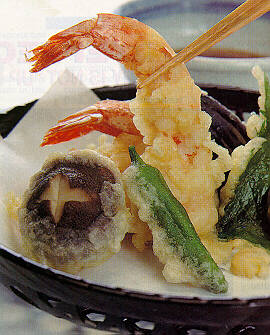
Dinner was tempura – now we all probably know what that is – HERE. But it was the way we ate that was intriguing. Dinner was in a tatami mat covered room, with the plates placed upon a large square table situated over a pit one metre deep. We sat at the edge of the pit and dangled our legs down into. How civilized! We didn’t have to sit cross-legged!

The food was delicious – and it was nice to have a home-cooked meal.

Kanemaru-san smoked his Golden Bat cigarettes throughout the meal, but reverently put them aside for the after-meal entertainment.

He brought out daisho (a pair of samurai swords) consisting of a wakazashi and a katana – I’ll direct you HERE for more information on these two types of weapons.

Kanemaru-san explained that his ancestors had been samurai… you could have knocked me over with a feather. He unwrapped the swords from a silk binding and held the larger of the two swords—the katana—reverently in two thick hands, as though he was making an offering to the gods. Even though it looked as though he was offering the sword to me, I was either smart enough or too stunned to reach out and take it. I’m pretty sure that you don’t touch another guy’s sword.

Besides the obvious wordplay, swordplay to the Japanese is not something you fool around with—especially when the 200+ year-old sword Kanemaru-san was holding was one that had lopped off more than its fair share of limbs in the past.

While it’s always possible that he was embellishing his ancestor’s story, I always got the feeling that Kanemaru-san was a straight shooter.

The sword was in pieces – IE hilt and pommel were apart from the supremely shiny blade—within minutes, he had carefully re-built it… and like the fine piece of weaponry it was, it sang as he slashed the air in front of him. That oxygen never had a chance, as in shock I tried to suck the air in.

Right there in front of me, Kanemaru-san transformed from a humble jowled-faced salary-man at the OBOE, back to tough as nails Bushido-following samurai. You could see him glow. It truly was exciting.

He told me via his dictionary that every time a blade is drawn from its hilt, it must claim blood, so he calmly placed his thumb near the blade to nick it and feed the sword... but that baby must have been sharper than Kanemaru-san because man, did his thumb splurt!

Holy crap, there was blood everywhere. I swear it didn’t even look like he had touched it, but he was bleeding pretty good. His yells brought his wife running, who quickly sized up the situation – shocked gaijin, screaming husband, a samurai sword and tatami mats splattered with blood and ran quickly for a towel and a Band-Aid.

Prying Kanemaru-san’s thumb from his mouth, she looked at the cut, shouted ‘bakayaro!’ (stupid idiot), smacked him on the back of the head, quickly wiped the blood away and applied the band-aid – a Hello Kitty one – all in about 4.7 seconds. The samurai had nothing on the quickness of a wife chastising a husband.

Done gushing, Kanemaru-san mumbled under his breath about something-this and something-that (I’m sure now, as a married man, that it had something to do with how a wife can suck all of the fun out of a party—oh, did I mention we had a few shots of sake (rice wine) at dinner? No? Well, that goes without saying and probably explains why we were fooling around with weapons--oh my gawd... he was a Japanese redneck!), and began cleaning the blood from the weapon before taking it apart and putting it away.

He looked at his thumb, grinned and painfully flipped through his dictionary to tell me one word “owie”. Who the heck put that in the Japanese/English dictionary? I mean, it was appropriate, but… anyhow, the actual Japanese word is ‘itai’, which should translate into hurt or pain. 'Owie' work, too.

It was 10PM, and it was time for bed. I slept  in a double-thick futon with a large feathery down comforter and slept very well. In the morning (7AM), Mrs. Kanemaru-san pointed to me and made a snoring noise. I have no idea what she meant – I heard nothing.

We had a horrible breakfast… a cold fried egg atop cold rice, with a glass of orange juice. If that’s a typical Japanese breakfast, I’ll never eat breakfast here again.

Mister and Mrs. Kanemaru, Tomohiro, their grandfather (where the heck had he been all evening and breakfast? – I’m kidding, he was around – just not pertinent to this particular story) and I got into the white van – a Toyota Cherry Vanette and headed back home to my place… but then they drove on by and headed along a road familiar to me… we arrived five minutes later in front of Ashley’s place in Nishinasuno Town. I’m pushed out of the van towards her place, I walk to her door – notice the Kanemaru’s are now standing outside the car – and grab her knocker. You know what I mean.

Ashley answers smiling, sees me and scowls.

Somewhere wondering what the heck is going on,

Andrew Joseph

Paradise By The Dashboard Light

One September night, I took a rare night off. There was no after-school teaching at the Ohtawara Friendship Association, no Ashley or Matthew over, and no phone calls to other AETs (Catherine Komlodi or Kristine South), whom I had huge crushes on.
Heading home on a week-night after a pleasant day of team-teaching at Sakuyama Junior High School in the south end of Ohtawara (a 20-minute car drive away from the downtown core where I lived), I visited a small grocer to see what pre-cooked meals they offered.
Hey… I’m all about convenience. It probably explains why I only had crushes on the two vastly different women mentioned above. Cryptic? Another blog.
Anyhow, I purchased a 2-litre bottle of Coke (my preferred choice of suicide) and a pre-cooked tonkatsu meal – breaded, deep-fried pork on rice with a nice thick Bulldog sauce—(this LINK has it all) that I only had to heat up in my microwave oven.
Yummers. Geez. Did I actually write that word. Sorry.
While this following statement might sound ridiculously inaccurate to my wife, back then I had a dining room table and I actually sat there while eating my dinner. I did have the television on, though.
It was 6:35PM, and a baseball game had just started between the perennial great Toyko Yomiuri Giants of the Central League and the Kintestsu Buffaloes of the Pacific League – both played in the Nippon Professional Baseball (NPB – akin to MLB in North America).
The Giants were/are owned by the Yomiuri newspaper—a daily Japanese paper that offers some national Japanese news, as well as the foreign stuff. There’s even an English version of it that I received at my doorstep every morning. I know I didn’t sign-up for it. I never ever paid a newspaper boy for it, and until this very moment never questioned who was paying for it on my behalf. Probably the OBOE. Thank-you!
Here’s a baseball lesson.
The Kintetsu team (not the pork tonkatsu team) was owned by the Kinki Nippon Railway Co. (later the Kintetsu Corp.), and was known through the years as the Kintetsu Pearls (1950-1958), Kintetsu Buffalo (1959-1961), Kintetsu Buffaloes (1962-1998) and Osaka Kintetsu Buffaloes (1999-2004).
Unbeknownst to me in 1990, in 2004 the team was sold to Orix Group—the owner of the Orix Blue Wave baseball team. The new owner merged the two teams into the Orix Buffaloes.
The Giants? Those guys are the New York Yankees of Japanese baseball. Sadaharu Oh holds the record for most homeruns in a career with 868. The Giants won nine Japanese League titles prior to 1950 when the NPB started and have since won 20 more championships.
These Giants are named after and have uniforms similar to the former New York and now San Francisco Giants—perennial also-rans to the evil empire that is the Yankees.
After finishing my meal, I laid down on my couch and gently rubbed the bruised areas of my body that still hurt a week after being hit by a car or two.
I should note that earlier this week I was hit a second time – this time right in downtown Ohtawara--and when you are hit in the downtown area, it hurts. I flipped over my handle bars and actually landed on the car’s front hood. I was okay – Japanese cars are mostly plastic. He popped his hood opened, pushed up on it from below and snapped it back into shape – none the worse for wear… although it’s possible I did get a concussion—I’m unsure as I did briefly pass-out.
Back to the couch. I curled up with a Japanese comic book purchased last blog while down in Tokyo with Matthew, and only half-glanced at the television while the game went on.
My telephone rang a few times—but since I was getting annoying phone calls from some Japanese woman who couldn’t speak English, I decided to ignore it—even if it was from any of the people mentioned above. Actually, I knew it wasn’t Kristine, as she was long-distance, and the phone rings differently.
By 8:45PM, it was apparent that Japanese comic books are not understandable by someone with zero Japanese language abilities, so I looked closer at the ensuing baseball game.
It was a tight one, with the Giants and Buffaloes tied at 3 in the 8th inning. The Buffaloes had this whiz kid pitcher named Hideo Nomo who had a twisty tornado-style delivery. The kid was a rookie, and was after his 18th win of the season against 8 losses. Instant favourite player as I watched him whiff a couple of Giants while throwing it 153kph (95mph).
With the Buffaloes going 1-2-3 in the top of the ninth, the Giants were up. It was just about to turn 9PM when the television station immediately shifted programming to some inane Japanese western—a samurai drama.
What the fa-?
What happened to the game? Surely it was accidentally switched at the TV station?
I waited a minute… then another… then another. It never came back. The game had gone the way of the samurai (except for this show which was entering its 14 year on tv).
Because the next day was Friday, I went to the OBOE and asked Hanazaki-san what was going on.
He shook his head and said that there is only two-and-a-half hours allotted to the televised baseball games, and if it goes over, too bad for the sports viewer.
I explained how sports in Canada and the U.S. seem to have a precedence over other televised properties, and you could see the tears welling up in Hanazaki-san’s eyes as I described what could only be the promised land for him.
He told me that that is the way things have always been for sports in Japan, and that the Japanese were not likely to change, because change doesn’t necessarily mean change for the better.
I told him it would, in this, be a change for the better. He sharply sucked air between his teeth, and nodded meekly and said that for all things Japanese, change is very difficult.
Ah so-ka (oh, I get it).
I then asked him about Japan inviting all of us foreigner AETs into the country to teach the kids English and internationalization—what about that, then?
He laughed, slapped me on my hurt shoulder (I wish I hadn’t taught them that) and said, “tabun” (maybe).
While I later learned that the Japanese have 47 different ways of saying ‘maybe’ (including sucking air between the teeth) , my ignorance of social custom made me believe I had made them believe that change was possible. Just not likely.
Later that night, the same two teams locked up again and this time made it to extra-innings before the broadcast switched out.
Months later in April of 1991, when Japan came out with its first set of baseball cards, my rookie card of ROY (Rookie-of-the year) Hideo Nomo showed that he had indeed won 18 games. Years later (in 1994)  Nomo-san became the first Japanese-born player to play in the MLB for the Dodgers. At least it wasn’t the Yankees.
Somewhere, this swinger had a miss.
Andrew Joseph

PS: In the photo below the title: that’s my dog Buster wearing my Kintetsu Buffaloes cap with my mint rookie card of Hideo Nomo. Buster later ate the cap believing it to be tonkatsu. He doesn’t like Bulldog sauce. He does like Meatloaf, who also sang today's title song.